Lith Corporation, founded in 1998 by a group of material science doctor from Tsinghua University, has now become the leading manufacturer of battery lab&production equipment. Lith Corporation have production factories in shenzhen and xiamen of China.This allows for the possibility of providing high quality and low-cost precision machines for lab&production equipment,including: roller press, film coater,mixer, high-temperature furnace, glove box,and complete set of equipment for research of rechargeable battery materials. Simple to operate, low cost and commitment to our customers is our priority.
Ion Sputtering Coater: Overview, Features, Process, Applications, Advantages, and Conclusion
An Ion Sputtering Coater is a highly specialized laboratory and industrial instrument designed for the precise deposition of thin films on various substrates using ion-assisted sputtering technology. As a refined method of Physical Vapor Deposition (PVD), this equipment enables the formation of uniform, dense, and adherent coatings that improve surface properties such as conductivity, durability, and imaging quality. Ion sputtering coating has become essential in research laboratories, electronics manufacturing, materials science, and sample preparation for analytical instruments such as scanning electron microscopy (SEM) and atomic force microscopy (AFM).
Overview
The Ion Sputtering Coater operates by generating a plasma in a vacuum chamber, usually with an inert gas like argon. High-energy ions from the plasma bombard a solid target, ejecting atoms that deposit onto the substrate to form a thin, controlled film. Unlike traditional evaporation techniques, ion sputtering allows for deposition of a wide range of materials, including metals, alloys, and certain insulating compounds, with minimal substrate heating. Advanced systems often incorporate magnetron or planar cathodes to enhance plasma density and deposition efficiency, ensuring high-quality films with uniform thickness and excellent adhesion.
Key Features of Ion Sputtering Coaters
Modern Ion Sputtering Coaters offer several features that make them versatile and reliable:
High-Vacuum Chamber: Reduces contamination and ensures high-purity deposition.
Ion or Magnetron Cathodes: Generate dense plasma for efficient sputtering while minimizing thermal stress on substrates.
Multiple Power Modes: DC, RF, and pulsed-DC modes accommodate both conductive and insulating target materials.
Automated Substrate Manipulation: Rotation, tilting, or biasing ensures uniform coating on complex or uneven surfaces.
Process Control and Monitoring: Integrated sensors and software allow real-time monitoring of deposition rate, thickness, gas flow, and plasma conditions.
These features collectively ensure reproducible, high-quality coatings suitable for a variety of scientific and industrial applications.
Ion Sputtering Coating Process
The coating process begins with evacuation of the chamber to a high vacuum, by the introduction of a working gas, typically argon. Upon applying voltage to the target, a plasma is generated. Positive ions are accelerated toward the target, dislodging atoms through momentum transfer. These atoms travel through the vacuum and condense on the substrate, forming a thin, adherent film.
Various sputtering modes are available depending on material and application:
DC Ion Sputtering: Suitable for conductive metals, providing stable and fast deposition.
RF Ion Sputtering: Enables deposition of insulating or ceramic materials without charge accumulation.
Reactive Ion Sputtering: Introduces reactive gases such as oxygen or nitrogen to produce compound films, including oxides, nitrides, or carbides.
Co-Sputtering: Simultaneous use of multiple targets allows creation of alloy or composite films with tailored properties.
These processes provide flexibility for achieving specific coating characteristics in terms of thickness, microstructure, and composition.
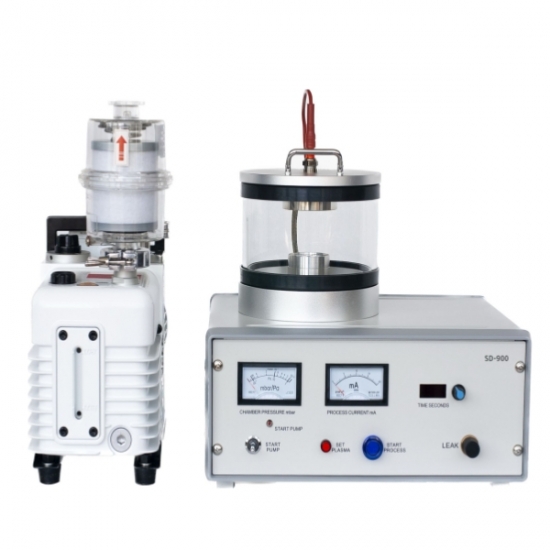
DC Sputter Coater
Applications
Ion Sputtering Coaters are widely used in research and industrial fields:
Microscopy Sample Preparation: Coats non-conductive samples with a thin conductive layer for SEM or AFM imaging, reducing charging effects and improving resolution.
Electronics: Deposits thin conductive or protective layers on microelectronic devices, sensors, and circuit boards.
Materials Science: Facilitates research on multilayer films, nanostructured coatings, and advanced functional materials.
Surface Engineering: Produces corrosion-resistant, wear-resistant, and decorative coatings on metals, plastics, and ceramics.
Energy Devices: Fabricates components for thin-film solar cells, battery electrodes, and transparent conductive oxides.
Advantages
The Ion Sputtering Coater offers several notable benefits:
Uniform and High-Quality Films: Produces smooth, dense, and strongly adherent coatings.
Wide Material Compatibility: Capable of depositing metals, alloys, semiconductors, and select insulating materials.
Low Substrate Temperature: Allows coating of temperature-sensitive materials, including polymers and delicate electronics.
Excellent Reproducibility and Control: Automated systems maintain consistent film thickness, composition, and microstructure.
Minimal Contamination: High-vacuum operation reduces oxidation and impurities during deposition.
Conclusion
In conclusion, the Ion Sputtering Coater is a versatile and essential tool for thin-film deposition across research, industrial, and analytical applications. Its precise control, high deposition efficiency, and ability to produce uniform, adherent coatings make it indispensable for microscopy, electronics fabrication, surface engineering, and materials research. By enabling high-quality coatings with minimal substrate heating and contamination, ion sputtering coaters continue to play a pivotal role in advancing material science, nanotechnology, and industrial surface modification.


 +86 13174506016
 Louis@lithmachine.com
 +86 18559646958
 18659217588
 English ▼


